false negatives in multimodal contrastive learning
the non-diagonal pairs in a minibatch are unlabeled, not negative
Contrastive learning excels at learning high-quality representations from web-scale datasets with implicit supervision, such as image-text pairs where captions serve as loose contextual cues rather than explicit annotations for the downstream tasks. It does so by bringing semantically similar pairs closer in the representation space while pushing dissimilar pairs away. In multimodal contrastive learning such as CLIP, however, it is often difficult to identify dissimilar pairs. In the common implementation, all image-text pairs within a minibatch that do not correspond to each other, the non-diagonal pairs, are considered to be the negative pairs. Yet these pairs sometimes have semantically similar information, leading to the problem of false negatives and alignment degradation.
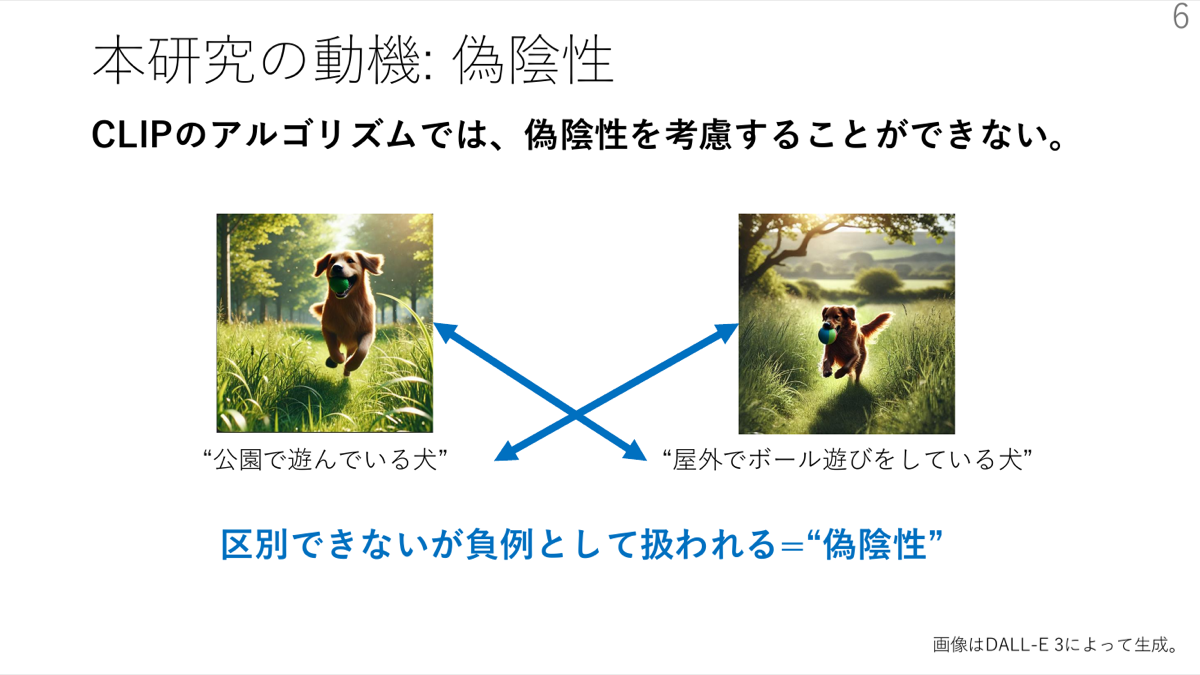
To mitigate this, I proposed PU CLIP, a modified contrastive learning objective where the non-diagonal pairs in a minibatch are treated as unlabeled, inspired by the positive-unlabeled learning technique. Experiments on real-world datasets suggest that CLIP training suffers from false negatives especially for large batch sizes, and that PU CLIP partially leads to improved zero-shot classification performance.
My bachelor’s thesis, supervised by Prof. Masashi Sugiyama and Prof. Takashi Ishida.
Shinnosuke Ono. Improving Multimodal Contrastive Learning with Positive-Unlabeled Learning. Bachelor’s thesis, Department of Information Science, the University of Tokyo, January 2025.